Blog reader Simon Dunkley from the UK pointed out that the wooden wagons I recently acquired through an estate sale were actually made by Roy Link for the 2nd version of his Crowsnest Tramway layout.
I'm even more pleased to own these items now!
Showing posts with label narrow gauge. Show all posts
Showing posts with label narrow gauge. Show all posts
9.25.2013

8.25.2013
scratch 16mm
I was very fortunate to recently obtain some items via an estate sale.


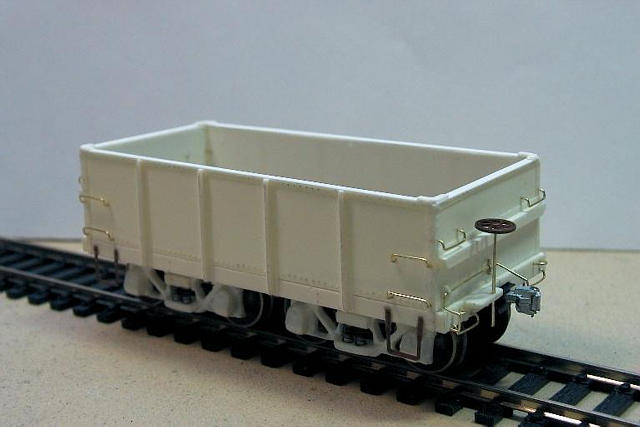
I was told that the late Mike South, a talented modeller in the Calgary area, scratchbuilt these 16mm scale (1:19.1) 32mm gauge (2') wooden 4-wheeled wagons. Little latches & catches, hinges & hooks abound. I am unsure if there is a prototype for these little gems.
A counterbalanced arm is fitted under one end of each car, equipped with magnetic chain to be pulled down to allow for hands-free uncoupling. I have not been able to try them out in a moving train, and I am a bit worried that they may be too delicate to survive a typical live-steam outing.
Some minor repairs needed to be made due to damage from shipping, and examination revealed that many of the finer details are not applied in a particularly robust manner. They may offer an incentive to create a small, operational diorama using a battery-powered critter.
Some minor repairs needed to be made due to damage from shipping, and examination revealed that many of the finer details are not applied in a particularly robust manner. They may offer an incentive to create a small, operational diorama using a battery-powered critter.


11.24.2012
smooth moves
Recently I was helping my dad wire up a 2-track staging yard for his O-16.5, Welsh inspired portable layout. Dad already had the yard built and attached, so I just packed up my VOM and other electrically necessary tools for the job. The wiring itself was easy.
The staging yard is a removable shelf that attaches to the back of the quarry section of the layout. Trains enter and leave the sceniced portion through a hole in the backdrop.
The intent is to be able to park a couple of short trains off scene, and selectively power one track or the other. The layout is controlled with a Stapleton walkaround DC throttle so a simple on-off-on toggle did the trick in the new yard. A flying lead equipped with Anderson PowerPole connectors brought power from the quarry section.
The entrance to the yard was via a curve ladi across the edge joint and, due to some dimensional assumptions, there was a short slope from the backdrop down into the yard tracks. The included 18" radius section lead directly into the point end of a Peco insulfrog turnout.
And this is where the trouble all started.
One section of rail at the frog end of the "previously enjoyed and slightly shortened" Peco turnout had an intermittent electrical connection. In addition, the points are powered from their adjacent stock rails via small wipers attached to the base of the point rails. As a loco was moving across the turnout, slight shifting of the components made the electrical contact fail unpredictably causing jerky motion or stalling.
I was performing my functional tests with an HO P2K SW 4-axle diesel that (normally) runs beautifully. However, dad only uses 0-4-2 Bachmann and Peco/Branchline locos on the layout. When placed in service they wouldn't make it across the turnout without constant poking and prodding. A bigger issue turned out to be the track geometry itself. The short slope at the backdrop caused the cab end 2-wheel truck on the Bachmann locos to drop down and leave the track entirely, and the curve leading into the shortened point-end of the turnout caused the loco wheels to pick the point tips and derail.
While the equalised chassis of the Peco/Branchlines 0-4-2 engine managed the distance better than the rigid frame Bachmann "Anglacised" On30 Porters, the consistency of operation was not sufficiently high. Something had to be done.
After much filing and adjusting, Dad & I came to the decision to alter the brackets holding the yard shelf to eliminate the slope. He then tore up the track to improve the flow by inserting a short straight section just before the points. The turnout itself will be replaced by a live-frog version so that the short wheelbase locos can enjoy fewer interruptions in electrical pickup.
I'm still waiting to hear if the planned corrections have eliminated all of the problems. The physical distance between our homes makes it difficult to collaborate effectively.
Lessons:
The staging yard is a removable shelf that attaches to the back of the quarry section of the layout. Trains enter and leave the sceniced portion through a hole in the backdrop.
The intent is to be able to park a couple of short trains off scene, and selectively power one track or the other. The layout is controlled with a Stapleton walkaround DC throttle so a simple on-off-on toggle did the trick in the new yard. A flying lead equipped with Anderson PowerPole connectors brought power from the quarry section.
The entrance to the yard was via a curve ladi across the edge joint and, due to some dimensional assumptions, there was a short slope from the backdrop down into the yard tracks. The included 18" radius section lead directly into the point end of a Peco insulfrog turnout.
And this is where the trouble all started.
One section of rail at the frog end of the "previously enjoyed and slightly shortened" Peco turnout had an intermittent electrical connection. In addition, the points are powered from their adjacent stock rails via small wipers attached to the base of the point rails. As a loco was moving across the turnout, slight shifting of the components made the electrical contact fail unpredictably causing jerky motion or stalling.
I was performing my functional tests with an HO P2K SW 4-axle diesel that (normally) runs beautifully. However, dad only uses 0-4-2 Bachmann and Peco/Branchline locos on the layout. When placed in service they wouldn't make it across the turnout without constant poking and prodding. A bigger issue turned out to be the track geometry itself. The short slope at the backdrop caused the cab end 2-wheel truck on the Bachmann locos to drop down and leave the track entirely, and the curve leading into the shortened point-end of the turnout caused the loco wheels to pick the point tips and derail.
While the equalised chassis of the Peco/Branchlines 0-4-2 engine managed the distance better than the rigid frame Bachmann "Anglacised" On30 Porters, the consistency of operation was not sufficiently high. Something had to be done.
After much filing and adjusting, Dad & I came to the decision to alter the brackets holding the yard shelf to eliminate the slope. He then tore up the track to improve the flow by inserting a short straight section just before the points. The turnout itself will be replaced by a live-frog version so that the short wheelbase locos can enjoy fewer interruptions in electrical pickup.
I'm still waiting to hear if the planned corrections have eliminated all of the problems. The physical distance between our homes makes it difficult to collaborate effectively.
Lessons:
- avoid sharp transitions in vertical and horizontal planes
- avoid curves leading into point end of turnout
- use guard rails where necessary
- ensure close fitting joints on curves
6.23.2012
survey says:
"More shade".
It gets hot here in the summer. In order to minimise exposure to the sun while running trains in the garden, I've settled on the 'more shade' versus 'less wet' option for the location of the track. Time will tell if this decision is a good one; I may need to invest in some Wellingtons.
I'll use a couple of garden hoses to establish the (very simple) arrangment of track. I'd like to minimise the impact on mowing and trimming the grass-like substances that cover the ground, so I'll have to leave room for the passage of a garden tractor at the periphery.
In terms of route, it will be a simple oval with a siding offering a spot for guests to 'steam-up'. 32mm gauge, single track. Still looking for an inexpensive method of raising the track off the ground; galvanised steel fence posts are the current front-runner for the job.
Going to visit another garden railroader who is using raised track this week. I vaguely recall his solution being practical and effective. More investigation is warranted, but I can (at least) lay out the route with wooden stakes and see how it looks.
It gets hot here in the summer. In order to minimise exposure to the sun while running trains in the garden, I've settled on the 'more shade' versus 'less wet' option for the location of the track. Time will tell if this decision is a good one; I may need to invest in some Wellingtons.
I'll use a couple of garden hoses to establish the (very simple) arrangment of track. I'd like to minimise the impact on mowing and trimming the grass-like substances that cover the ground, so I'll have to leave room for the passage of a garden tractor at the periphery.
In terms of route, it will be a simple oval with a siding offering a spot for guests to 'steam-up'. 32mm gauge, single track. Still looking for an inexpensive method of raising the track off the ground; galvanised steel fence posts are the current front-runner for the job.
Going to visit another garden railroader who is using raised track this week. I vaguely recall his solution being practical and effective. More investigation is warranted, but I can (at least) lay out the route with wooden stakes and see how it looks.
11.05.2011
coulda, woulda, shoulda, didn't
I actually turned down the offer of many dozen Railfan & Railroad magazines (in proper binders) the other day. Who would have thought I'd reject yet more reading material? Could've taken up the space I just emptied last week...
Did receive 3 volumes published by Wild Swan in the UK from a bookseller I haven't dealt with before, British Railway Books. Great service. Two are by Gordon Gravett on 7mm Modelling techniques, and the third is about Narrow Gauge Modelling in the British style. If I was ever required to get rid of all my reference material except one source, I would keep the Wild Swan books.
Missed a chance to buy something that is now out of stock everywhere. Hadn't thought a mass-market item would disappear so quick. I guess times really are changing; even large manufacturers are no longer making thousands of the same SKU only to have the remainder sit on their shelves for years. Should get stuff while you can.
A portion of our S Scale group will be in Milwaukee for Trainfest next weekend. I expect about 30' of modules will make the 800+ km journey to the show. I didn't book time to go, as I couldn't justify the trip; too many other things requiring attention and funds at the moment.
Did receive 3 volumes published by Wild Swan in the UK from a bookseller I haven't dealt with before, British Railway Books. Great service. Two are by Gordon Gravett on 7mm Modelling techniques, and the third is about Narrow Gauge Modelling in the British style. If I was ever required to get rid of all my reference material except one source, I would keep the Wild Swan books.
Missed a chance to buy something that is now out of stock everywhere. Hadn't thought a mass-market item would disappear so quick. I guess times really are changing; even large manufacturers are no longer making thousands of the same SKU only to have the remainder sit on their shelves for years. Should get stuff while you can.
A portion of our S Scale group will be in Milwaukee for Trainfest next weekend. I expect about 30' of modules will make the 800+ km journey to the show. I didn't book time to go, as I couldn't justify the trip; too many other things requiring attention and funds at the moment.
9.17.2011
tick the boxes
In an effort to focus, pare down, and lighten up I've been considering what I like most in the hobby; a process brought on by having too much to think about, too much to choose from, and too much to complete. There is a primary pattern to the result, and it's narrow gauge. The themes include logging, mining, and industrial topics. There is little desire for a basement-filling empire, but a strong inclination to start the garden railway as soon as next Spring rears its head (and the ground dries up).
I'm much more interested in individual models than complete systems, and more inclined towards the critter than the Challenger. There are plenty of opportunities to work on other people's layouts, so not having anything more substantial than a micro or a few modules will be fine. Electrical, benchwork, and tracklaying tasks will all present themselves in sufficient quantity regardless of the scope of any one project. The decision to build kits rather than buying RTR has also allowed me to decide what stays and what goes.
Scale is not important on an individual level, as the large layout scenario is unlikely. Being able to dabble in 16mm or 7mm, 3/16" or 1:76 as the mood strikes has very broad appeal. I suspect that a display cabinet (or two) for finished items, coupled with a portable micro, a pair of modules, and a garden patch will be the end result of the soul searching...
I'm much more interested in individual models than complete systems, and more inclined towards the critter than the Challenger. There are plenty of opportunities to work on other people's layouts, so not having anything more substantial than a micro or a few modules will be fine. Electrical, benchwork, and tracklaying tasks will all present themselves in sufficient quantity regardless of the scope of any one project. The decision to build kits rather than buying RTR has also allowed me to decide what stays and what goes.
Scale is not important on an individual level, as the large layout scenario is unlikely. Being able to dabble in 16mm or 7mm, 3/16" or 1:76 as the mood strikes has very broad appeal. I suspect that a display cabinet (or two) for finished items, coupled with a portable micro, a pair of modules, and a garden patch will be the end result of the soul searching...
project shuns
There are a few projects which I feel must be completed before too long. The first two, small efforts involve 3D modelling and brass kit building.
The former relates to the WDLR (War Department Light Railways) steel and wood wagon bogies. There are a few modellers who would like to be able to buy (nearly) RTR bogies for their 7mm scale models. I will be converting the available 2D files into 3D, and uploading them to a 3D print service. With planning and a bit of luck, this should be a straightforward excercise (despite a certain rustiness with the 3D side).
The latter involves a long-overdue review kit that was sent to me for evaluation. Apparently I was the only one foolish enough to think burnt fingers and strained eyes were a desirable experience. It is an Irish OOn3 (1:76 scale, 3' gauge) coach. The sides and ends of the structure have been cut away from their frets and soldered together with minimal damage to the thin plates. The under frame is awaiting W-iron and wheelset installation. I was fortunate to obtain properly gauged wheelsets and accompanying bearings from the UK.
The former relates to the WDLR (War Department Light Railways) steel and wood wagon bogies. There are a few modellers who would like to be able to buy (nearly) RTR bogies for their 7mm scale models. I will be converting the available 2D files into 3D, and uploading them to a 3D print service. With planning and a bit of luck, this should be a straightforward excercise (despite a certain rustiness with the 3D side).
The latter involves a long-overdue review kit that was sent to me for evaluation. Apparently I was the only one foolish enough to think burnt fingers and strained eyes were a desirable experience. It is an Irish OOn3 (1:76 scale, 3' gauge) coach. The sides and ends of the structure have been cut away from their frets and soldered together with minimal damage to the thin plates. The under frame is awaiting W-iron and wheelset installation. I was fortunate to obtain properly gauged wheelsets and accompanying bearings from the UK.
10.20.2008
portly porter problem?
Dad purchased a Bachmann On30 porter (0-4-2) to use on his proposed 7mmNG, Welsh quarry inspired portable layout. From KeyKits in the UK, we obtained suitable Anglicising pieces (Wrightlines W996 cab kit and W963 chimney). The conversion itself was prompted by Brian Fayle's 7mm micro-layout workhorse and other examples from his website. The Bachmann chassis is a known "good runner" so we anticipate good service.
It did run well right out of the box, however, once the whitemetal cab pieces were substituted for the plastic details, the ends of the siderods started banging into the underside of the cab floor. "Too much weight!" was the initial thought but, upon partial disassembly, it was observed that one of the rear axle U-grooves in the plastic frame was deeper than the other. This caused the rear axle to tip out of true with respect to the front axle and the engine developed a list to one side.
This tilt caused the engineer's side of the cab floor to interfere with the siderod motion. ACC'ing a ~.015" thick pad of shim brass at the bearing surface of the over-deep U-groove solved the problem. Now the engine sits level on its axles and travels without any apparent binding.
The new cab assembly is secured to the stock footplate with flat head 1-72 machine screws countersunk into the underside of the floor. A stemwinder brake stand has been added to the footplate. The Bachmann steam dome needs to be removed from the saddle tank, and a simplified water fill hatch needs to be fabricated. The engine can then be painted and lined for service.
It did run well right out of the box, however, once the whitemetal cab pieces were substituted for the plastic details, the ends of the siderods started banging into the underside of the cab floor. "Too much weight!" was the initial thought but, upon partial disassembly, it was observed that one of the rear axle U-grooves in the plastic frame was deeper than the other. This caused the rear axle to tip out of true with respect to the front axle and the engine developed a list to one side.
This tilt caused the engineer's side of the cab floor to interfere with the siderod motion. ACC'ing a ~.015" thick pad of shim brass at the bearing surface of the over-deep U-groove solved the problem. Now the engine sits level on its axles and travels without any apparent binding.
The new cab assembly is secured to the stock footplate with flat head 1-72 machine screws countersunk into the underside of the floor. A stemwinder brake stand has been added to the footplate. The Bachmann steam dome needs to be removed from the saddle tank, and a simplified water fill hatch needs to be fabricated. The engine can then be painted and lined for service.
12.09.2007
getting steamed

Over the summer I was able to attend a steam-up at a local enthusiast's home. Wow! There are some seriously interesting live steam engines out there; available either as kits or ready-to-run. The majority of the equipment at the event was 16mm scale (~1:19 proportion) and ran very well, often at surprising velocity.
16mm scale appears to be the ideal scale to pursue construction of the relatively small War Department equipment - a live steam, 2' gauge Baldwin is actually available in this scale (but I didn't dare ask the price).
4.23.2007
you'd think I'd learn
Overall, the 2nd Ontario Narrow Gauge Show went well. While not being attended by thousands of rabid modellers, the 130+ visitors, vendors, and exhibitors seemed to enjoy themselves thoroughly.
The continuous loop micro-layout form of display was the overwhelmingly popular format, and will likely continue to be so for the foreseeable future. Despite the limitations of the style (primarily lack of operational possibilities, very tight curves, and short length of run), the benefits of quick setup and unattended running are attractive to a great many builders - especially the lone wolves.
On the other front, the 3-section "Cooper & Sawyer" On30 display layout of Pete Reisiger was present next to his Creative Works 3D stand. Pete has indicated that he's thinking of trying a FreeMOn30 style replacement as the C & S is due for retirement.
The Peterborough Model Railroaders had a deceptive point-to-point on a board of about 3'x5' dimension (possibly smaller). It appeared to be a continuous run at first glance, but offered some shunting and short runs in a nicely sceniced package.
Our FreeMOn30 setup consisted of the large river gorge, loop & wye, and tiny creek scenes as only 3 members with modules could attend. The lack of the harbour terminus made it a "pointless to loop" arrangement, and required a quick stop before a train could take the long plunge to the floor. Our 4th member brought excellent scratchbuilt ore cars, flats, and a caboose all equipped with Sergent couplers.
Thanks to the Digitrax Empire BuilderII system and a passing siding on the loop, we were able to keep two trains in operation at all times. One with the BLI C-16 and the other with a Bachmann Climax equipped with a Soundtraxx PnP decoder. Four UP5 panels were arrayed along the layout using clamps under the fascia to provide throttle plug-in points.
Operationally, the major problems evidenced were with the long rigid wheelbase of the C-16 over the pointwork, and the pickup wipers on the virginal Climax which kept breaking contact on sharp radii. However, the worst offense was the overall alignment of the tiny Whisky Creek module. Thanks to the intent to build the unit as light as possible, a bow developed along its short length that resulted in unacceptable track humps at each interface. These were sufficient to cause uncoupling of the engine from its cars. It may be possible to repair the module, but it might not be worth doing in terms of effort. Likely it will be relegated to a display/photo stand.
It's possible that the show will now alternate with the Great British Train Show in a biennial cycle, with the NG Show on the odd years. This will allow for more progress to be made, or entire new layouts to be built in the intervening timeframe to encourage display variety.
4.03.2007
prep for Schomberg
More On30 module progress was achieved during this past weekend. Trackwork was re-checked and yet more spikes were added where necessary. The wye, gorge & curve module sets were connected together, and the fascias were cleaned up & primed.
Once the setup was checked for shorts, the Bachmann Davenport travelled over all the trackwork looking for areas where short-wheelbase locos might encounter problems with electrical pickup. Reversing the engine through the wye was tested several times.
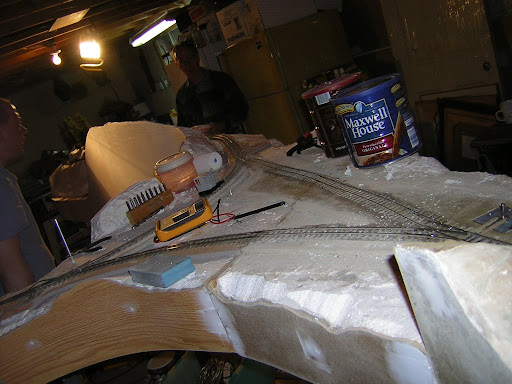
To the best of all of our recollections, the outside-framed consolidation and the C-16 both successfully negotiated the least smoothly aligned leg of the wye (which still needs a short siding installed) during the Christmas Train Show. We have noted, however, that it is unlikely that the Forney or the K-27 will be able to travel over all of the trackwork in its current state.
Scenic treatment prior to the show will consist of mis-tinted acrylic paint covered in sand and/or sanded grout. Some coniferous trees have been purchased from MountainView Depot to "spruce" up the landscape a bit.
We are still debating the final fascia colour. The intent is to provide a surface that will present a uniform appearance, resist fingerprints & other marks, and keep the eye focused on the scene rather than the benchwork. We have it narrowed the choices down to a few very dark tones but are not certain whether a bluish, greenish, or neutral cast will be the best looking in the end.
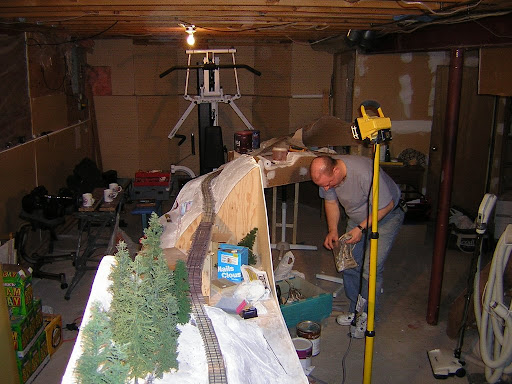
More contour forms, rockwork and trestle bents need to be installed on the gorge set, the loop portion needs additional cleanup, and Whisky Creek definitely requires finishing and a new bridge deck but, we are probably doing OK considering how infrequently we manage to get together for these work sessions.
Once the setup was checked for shorts, the Bachmann Davenport travelled over all the trackwork looking for areas where short-wheelbase locos might encounter problems with electrical pickup. Reversing the engine through the wye was tested several times.
To the best of all of our recollections, the outside-framed consolidation and the C-16 both successfully negotiated the least smoothly aligned leg of the wye (which still needs a short siding installed) during the Christmas Train Show. We have noted, however, that it is unlikely that the Forney or the K-27 will be able to travel over all of the trackwork in its current state.
Scenic treatment prior to the show will consist of mis-tinted acrylic paint covered in sand and/or sanded grout. Some coniferous trees have been purchased from MountainView Depot to "spruce" up the landscape a bit.
We are still debating the final fascia colour. The intent is to provide a surface that will present a uniform appearance, resist fingerprints & other marks, and keep the eye focused on the scene rather than the benchwork. We have it narrowed the choices down to a few very dark tones but are not certain whether a bluish, greenish, or neutral cast will be the best looking in the end.
More contour forms, rockwork and trestle bents need to be installed on the gorge set, the loop portion needs additional cleanup, and Whisky Creek definitely requires finishing and a new bridge deck but, we are probably doing OK considering how infrequently we manage to get together for these work sessions.
12.20.2006
real live steam
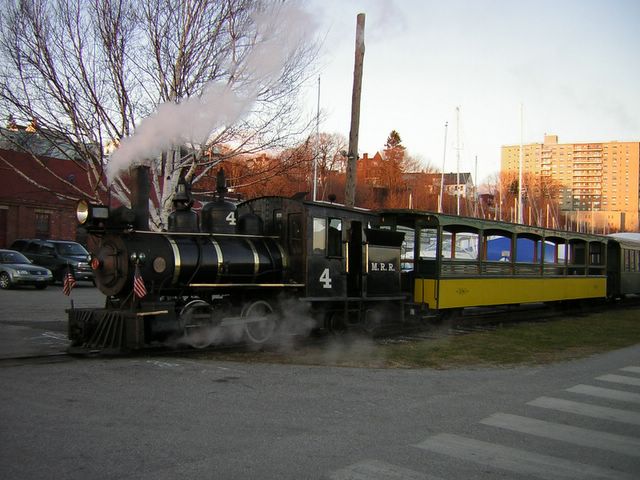
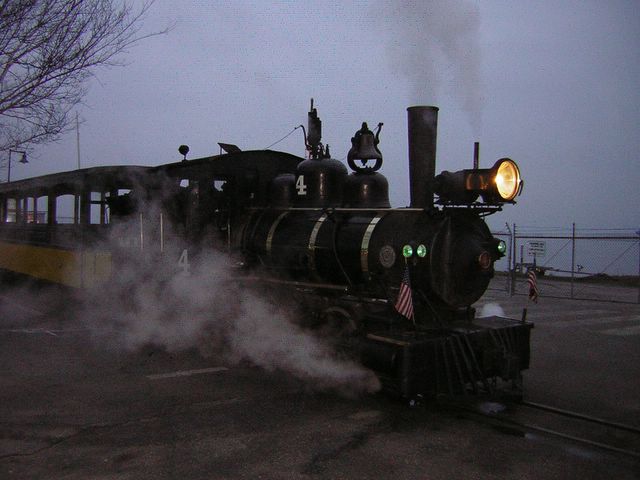
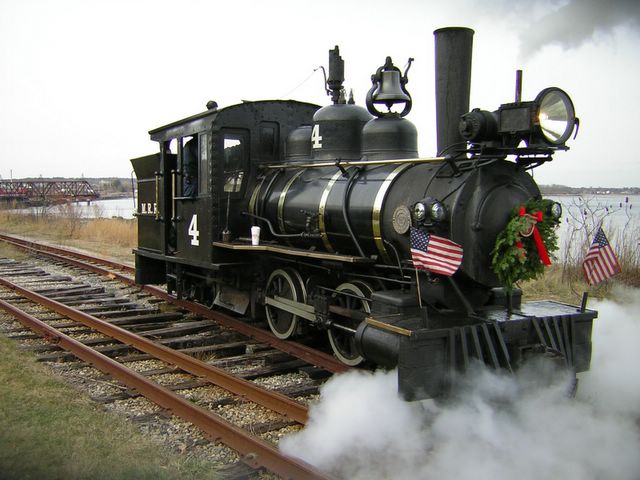
I had a rare chance to work as a crew member on a preserved steam locomotive this past weekend. It was at the Maine Narrow Gauge Museum in Portland, ME. The engine was ex Monson RR #4, an 0-4-4 Forney built by Vulcan in 1918.


The hospitality, accommodation, and seafood in Portland were all great. The days were long and the work was dirty. Everything I wore was covered in coal dust, oil, and grease. That said, it was well worth the distance travelled and the effort involved in order to enjoy the experience. It was a privilege to be able to work with the various engineers, firemen, and museum staff.

If you get a chance to volunteer at a steam preservation line, please consider doing so. These pieces of history and the knowledge to operate and maintain them are slowly but surely disappearing. You may never get another opportunity.
The hospitality, accommodation, and seafood in Portland were all great. The days were long and the work was dirty. Everything I wore was covered in coal dust, oil, and grease. That said, it was well worth the distance travelled and the effort involved in order to enjoy the experience. It was a privilege to be able to work with the various engineers, firemen, and museum staff.
If you get a chance to volunteer at a steam preservation line, please consider doing so. These pieces of history and the knowledge to operate and maintain them are slowly but surely disappearing. You may never get another opportunity.
4.25.2006
Narrow Gauge Madness
The show has come & gone. From all reports it should be counted as a success. Not bad for a first effort on the part of the "Narrow Gauge Madness" crew. The website for the event will have pictures of layouts and contest entries fairly soon.

Our fearless leader drawing door prizes about midday. About a dozen of the participants donated books and kits for draw prizes.

The vendor area seen from the entranceway. The local Lion's Club provided catering services for the day's activites. The smell of barbequing hamburgers, hotdogs and sausages was enticing.

The vendor area seen from the rear of the 1st floor. Quite a good selection of materials; we had restricted the vendors to bringing only narrow guage or gauge-neutral items (tools, scenic material, books, wood, plastic, metal, kits and RTR equipment).

Our fearless leader drawing door prizes about midday. About a dozen of the participants donated books and kits for draw prizes.
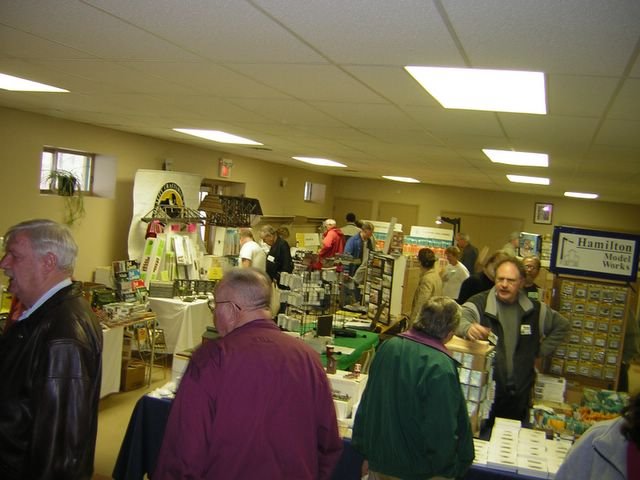
The vendor area seen from the entranceway. The local Lion's Club provided catering services for the day's activites. The smell of barbequing hamburgers, hotdogs and sausages was enticing.
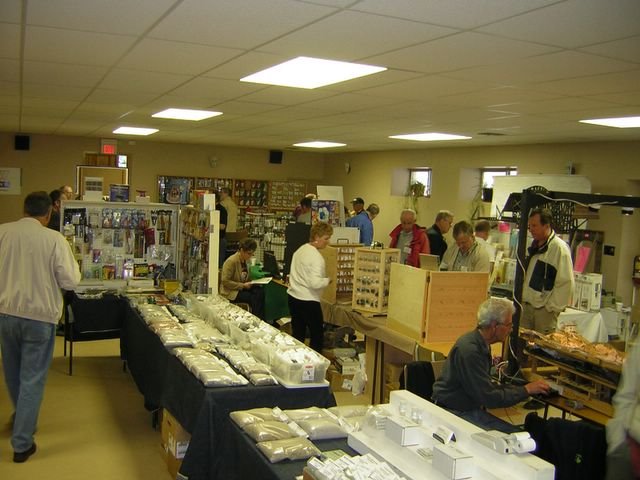
The vendor area seen from the rear of the 1st floor. Quite a good selection of materials; we had restricted the vendors to bringing only narrow guage or gauge-neutral items (tools, scenic material, books, wood, plastic, metal, kits and RTR equipment).
6.30.2005
1/2"n2
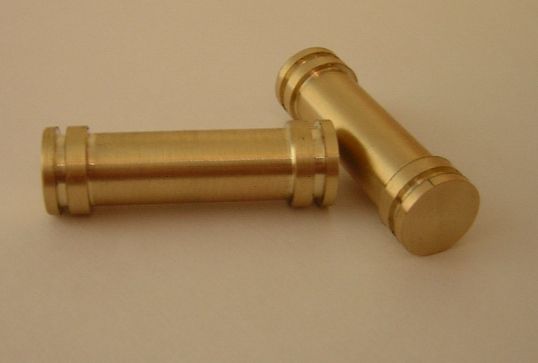
One of the oddball combinations I'm working in is 1/2"n2. To assist with tracklaying efforts, I made up a set of brass roller gauges and a small, 3' wheelbase bogie frame.
The roller gauges were set up for code 100 track and .080" flangeways. In practice, the .080" flangeways are too wide. Despite the fact the scale is relatively large, the wheels that will be employed are bigger HO or medium diameter S scale with an RP25 contour. The gauges will have to be modified for a narrower flangeway.
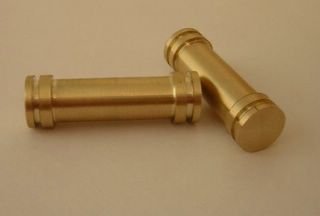
The wheelsets on the test bogie are Jaybee 36" diameter (HO) with pointed axles. The axles were cut in half and a section of brass tubing was slipped over the stubs to widen the gauge to 1". The frame consists to two flat plate sides with a solid rod spacer at each end fastened with 2-56 screws. The sides are fitted with Markits (Romford) needle bearings for the axles.
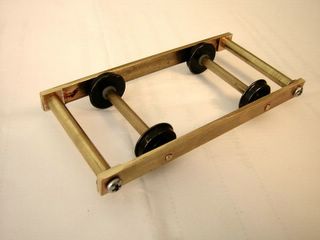
The sides were ACC'd together and milled to length. Then the bearing locations were marked, centre drilled, and drilled 5/32". The bearings are held in place with Loctite 242. They slipped into the holes without passing completely through the plate frame. The frame will free-roll down less than a 1% grade.
Motive power for this project will be a 4-wheeled electric trolley with a (non-functioning) pantograph. The chassis will require a 3-point suspension to ensure electrical pickup from the rails.
The roller gauges were set up for code 100 track and .080" flangeways. In practice, the .080" flangeways are too wide. Despite the fact the scale is relatively large, the wheels that will be employed are bigger HO or medium diameter S scale with an RP25 contour. The gauges will have to be modified for a narrower flangeway.
The wheelsets on the test bogie are Jaybee 36" diameter (HO) with pointed axles. The axles were cut in half and a section of brass tubing was slipped over the stubs to widen the gauge to 1". The frame consists to two flat plate sides with a solid rod spacer at each end fastened with 2-56 screws. The sides are fitted with Markits (Romford) needle bearings for the axles.
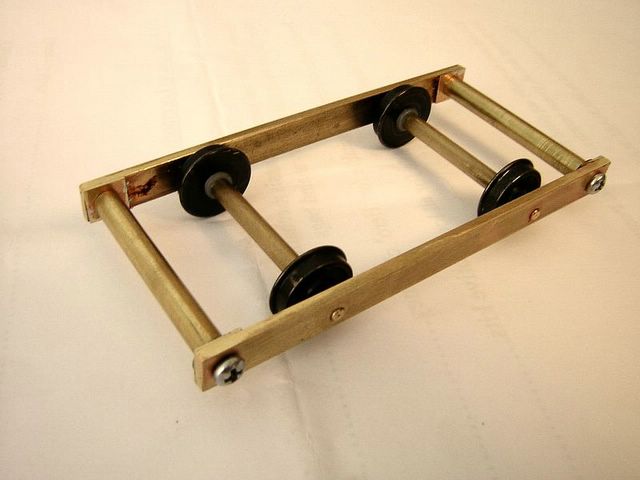
The sides were ACC'd together and milled to length. Then the bearing locations were marked, centre drilled, and drilled 5/32". The bearings are held in place with Loctite 242. They slipped into the holes without passing completely through the plate frame. The frame will free-roll down less than a 1% grade.
Motive power for this project will be a 4-wheeled electric trolley with a (non-functioning) pantograph. The chassis will require a 3-point suspension to ensure electrical pickup from the rails.
5.04.2005
narrow gauge turntable drive

Part of a turntable mechanism built for a good friend. The pivot is a 1/4" mono phone plug and jack combination. A brass bushing was made to accept the cable end of the phone plug, and a nylon gear was bored out to fit the outside diameter. A brass plate to support the superstructure (built separately) was affixed to the top of the bushing. Power fed from the tip and ring contacts on the phone jack allows for sound equipped locos to remain uninterrupted throughout the turntable rotation. The wires are run from the plug solder tabs up to the rails inside the bushing body.
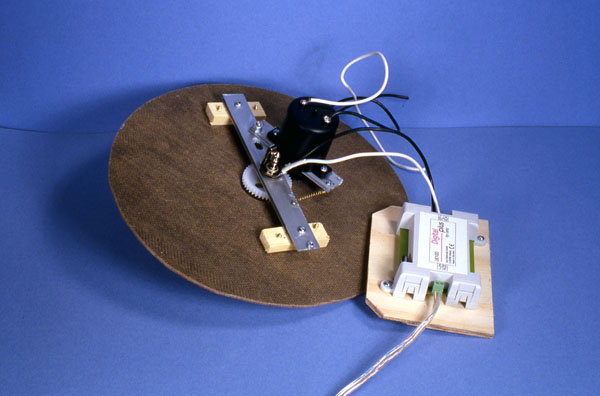
The turntable is powered by a Switchmaster stall motor mounted on a spring loaded swing arm. The spring keeps the stall motor pinion gear in mesh with the bridge pivot gear. The entire bridge can be removed from the top of the layout for maintenance or detailing by simply pulling upwards. A Lenz automatic reversing relay deals with the polarity change during rotation.
4.28.2005
wiggly jiggly
Moffett Models custom made this great Sn42 kit for the local Newfoundland modellers group. It represents a 25T ore car from the Buchans Railway (later ASARCo.) used to carry lead and zinc concentrates. The cars were known as "wiggly jigglies" as they were unstable at higher speeds.
An unfortunate mishap rendered the masters unusable for future moulds, and we wore out the initial RTV moulds making nearly 60 of these little cars. They are amazingly accurate, having been made from the original erection drawings. The kit included sprung (working!) Andrews trucks. The short wheelbase does make the cars act like the prototype; they do wiggle back and forth on the track.
The wonky looking grab irons on this example were my attempt to duplicate the look of the original's oddly shaped fittings. My remaining units will be assembled slightly differently. Certainly none of the in-service units had metalwork that was this "pristine" and flat. I shall have to find a reliable way to "beat up and dent" the resin castings without rendering them unusable.
4.27.2005
prototype Welsh locomotive

Ex Corris Railway 0-4-2 locomotive "Sir Haydn" on the 2'-3"gauge Talyllyn Railway (Nant Gwernol station), Wales, May 2004. The rake of coaches behind includes 1st and 2nd class cars and a baggage wagon. The TR is the oldest preserved railway in the world. I managed to convince my travelling companion that a side trip to Wales was only a short jaunt from Shrewsbury in Shropshire. Thus I was able to see this living relic first-hand.
On the way up to the peak, we disembarked at the Dolgoch station and hiked up to the very picturesque Dolgoch Falls. Given that time was short we (sadly) stopped for only a while before walking back to the station along a path that passed under the ancient stone railway viaduct, 50 or 60 feet overhead.
At Nant Gwernol, the engine ran around the train and re-coupled to the downhill end. The jovial conductor sat in our open compartment and spoke of the local history in a wonderfully thick, Welsh accent (possibly only put on for the benefit of foreign visitors). We made it back to Tywyn Wharf (which is not on a body of water - a "wharf" in this case was the old standard gauge interchange platform) on the final train of the day.
Due to our late return, we just missed the Honeyed Ice-Cream factory visit in Tywyn. This did not sit well with my travelling companion, who had been looking forward to (and had been promised) the treat. I, however, was somehow looked upon with great favour and was gifted a shard of the slate roof of the original station circa 1865 by one of the historical society members. This was made possible due to the construction of the new museum building that will adjoin the old station, where some material had been dislodged in the process. I was (and still am) really pleased with this unforeseen present.
nickel-silver chassis

O-16.5 Talyllyn 0-4-2 chassis (Branchlines). The trailing bogie and the rear axle share some compensation via a 3-point pivot arm. In practice, however, the range of motion appears somewhat limited. A can motor drives the rear axle through a worm reduction. Pulling power is enhanced by the weight of a whitemetal superstructure.
This was quite a "trial by fire" for me as I had not undertaken assembly of a British kit before. The manufacturers do expect you to have a certain level of knowledge of their local prototypes; a fact emphasised by their omission of "obvious" information that would assist the neophyte.
At this stage the siderods and main rods had not been fitted. The unit had to be disassembled to install the motor and gearbox. The gearbox rides with the driven axle, so the worm stays in mesh at all times.
The kit is simplfied due to the prototype having "inside" valve motion which is hidden from view and therfore not included in the fretwork or castings that need to be assembled.
4.26.2005
a thing of beauty...

...is a joy forever. A selection of largely scratchbuilt models in 1:64 (S) scale of Newfoundland 42" gauge prototypes. ASARCo., Buchans, GFCR, and CN/NR railways are represented in this display at the Maple Leaf 2003 NMRA convention, Toronto, Canada.
hen's teeth

A very, very rare sight. Two WWI vintage protected Simplex locomotives in operational condition. Powered by 7 litre, 4-cylinder petrol engines yielding 40hp. Leighton-Buzzard Light Railway "Twin Turtles Day", May 2004. I was fortunate to obtain ticket #001 for the event. #3090 was fully restored by the "Salvage Squad" TV programme crew in the UK.
Subscribe to:
Posts (Atom)