The Christmas Train Show is now over and there has been time for some reflection.
1) If our group ends up in front of the 18' high roll-up door again next year, I'll simply turn around and head home. I have no desire to stand in near-freezing wind for 4+ hours trying to set up the modules for a third show in a row. Someone else can have their turn, or the organisers can re-arrange the entry and exit of vehicles from the exhibition space.
2) Attendance this year and last seemed less and, in fact, it was. Turns out that another 2-day train show at the other end of the city has been scheduled for the same weekend as the TCTS two years in a row. This splits the attendance of vendors, layouts, and the public. Oh, and a number of other, 1-day shows in the general area were held on either the Saturday or Sunday. Having the show on the same weekend as the Santa Claus Parade smacks of poor scheduling as well.
3) Other than the presence of the various club displays, there is very little to draw a crowd of enthusiasts. Certainly the general public comes by to bring children to see the trains, but very few modellers outside of the exhibitors themselves seem to attend. Very few 'show specials' from vendors, no large manufacturers, no flea-market tables.
Without serious changes in the approach of the organisers, the show will continue to decline to the point where none of the vendors or exhibitors will attend.
11.27.2010

cutting the cords
Just transferring all of the iPod content from the PC to the iMac via my LAN. This will be the ideal chance to organise the many "miscellaneous" files into a better structure.
My address book has already been transferred from the PC (Thunderbird LDIF export & import). iCal is being filled with dates & times for various events. I'll finally be able to sync those important details to the iPod; no straightforward way to do that on the PC.
*EDIT* The transfer took much longer than expected. Cleaned up many duplicate files and shuffled appropriate collections into folders. Added a pile of missing album art (more still to do) and restored the iPod to factory defaults before the resync. Just under 3800 items to copy over at USB2.0 speeds. I'll find something else to do for a couple of hours. *EDIT*
11.26.2010
service survives
Again, I've had two excellent customer service experiences...
1) Broadcast Systems & Equipment - John Waling of BSE took the time to understand the type of hardware I needed to add extra functionality to an audio mixer. He deals with much bigger customers all the time, but he still made the effort to locate, hook-up, test, and allow me to hear for myself the hardware in question. Brilliant.
2) Long & McQuade - the staff at the shop helped me to quickly locate the cables I needed to hook up the new piece of hardware (BSE makes cables to order on a per-project basis) and had me on my way in minutes. No wasted time, no blank stares in response to my questions.
11.19.2010
finally fun
After the demise of the Commodore Amiga, there remained only two real choices of computing platform. The Intel-based, so-called "IBM compatible" personal computer, and the underdog Apple Macintosh. At the time of the Amiga's passing, monetary restrictions prevented the exploration of the latter path. Experience with the Mac OS (5 or 6) via a hardware emulation board on the Amiga gave a sketchy impression at best. Pending employment in a DOS/Win environment equipped with x86 hardware cinched the decision. The MS route was followed, and computing operations proceeded in a predictable fashion thereafter.
At last, however, the situation has righted itself. Thanks to a combination of good fortune and excellent timing, a G5 iMac has been obtained. Many of the hardware related frustrations associated with the MS OS and firmware tomfoolery has vanished overnight. Every peripheral transfer (often without any drivers or software) to the new machine has taken less time than its initial installation with accompanying discs and documentation on the 'PC'.
Despite virtually identical specifications of 2GHz CPU/2Gb SDRAM/250Gb HD, comparative functional testing of the two units (using identical applications) reveals a significant improvement in performance in favour of the Mac. Using the new machine is a real joy. Computers are finally fun again.
once more unto the breach
Another Christmas Train Show is once more upon us. As usual, the last-minute rush to complete outstanding work on the display elements threatens to deaden the mood. How events unfold over the next two days will dictate future participation.
There remains to emerge a truly great train show in this region. The last one of any magnitude or consequence was in 2003, and that one very nearly didn't happen at all due to politics and knee-jerk reflexes.
It is sad to realise that, in an urban locale with 8+ million souls within reasonable driving distance, we cannot collectively attract more than a few thousand largely passive attendees for an annual exhibition. Perhaps it is because the displays do not change appreciably from year to year, or that the vendors fail to offer any real bargains. Perhaps it is because the major manufacturers choose to regularly absent themselves from the event, and the minor ones cannot afford to attend.
Frankly, there are other annual activities occurring within this timeframe which are becoming more appealing...
10.19.2010
podcast premier pending
The Model Railway Show launches November 1st
Free podcast engages model railroading enthusiasts in thought-provoking, fun-filled journey
(Toronto, Canada) – November is National Model Railroad Month, and we’re celebrating with the launch of The Model Railway Show. The first episode will be available November 1, 2010.
This free podcast follows the classic radio newsmagazine format, featuring the hobby’s best-known enthusiasts, along with the hard workers and innovators that keep this exciting hobby moving ahead.
Each episode of The Model Railway Show will run approximately 20 minutes, with quick yet informative interviews with a pair of guests. Topics will cover the full spectrum of the model railroad hobby – ranging from interviews with authors, editors and publishers, to chats with officials at the various organizations that keep the hobby growing, in North America and around the globe.
The Model Railway Show will broadcast twice a month over the Internet as a podcast. Listeners can subscribe at no cost via iTunes and have shows automatically delivered for listening on their computer, iPod or other digital music device. Alternately, listeners can monitor the show’s web site and RSS feed for new episodes, which can be download directly from the show’s servers in mp3 or m4a/AAC formats.
Details on how to listen by either method are provided on The Model Railway Show web site:
www.themodelrailwayshow.com
The Model Railway Show is hosted by Trevor Marshall and Jim Martin. In addition to being lifelong model railway enthusiasts who have worked in a wide variety of scales and gauges, Trevor and Jim both bring professional journalism, writing and radio backgrounds to the show.
4.02.2010
yakkity yak

I've been very lucky to be able to participate in a great number of Model Rail Radio podcasts over the last couple of months. The audio police have yet to come banging on my door in the wee small hours demanding that I stop hemming & hawing while I talk.
Topics vary widely, from benchwork to DCC to planning to updates of various ongoing projects. Content is largely generated from listener feedback; I'm never quite sure what will be discussed.
light work
Imagine my horror when I took the module set to the most recent exhibition, only to discover that the scenic work I'd done was completely the wrong colour under proper lighting conditions. So much for 'making do' with what I had.
Installation of two single fluorescent fixtures, equipped with daylight tubes, over the modelling bench in the shop has revealed exactly what I suspected; namely, that it's a miserable dark pit. I'll need at least one more single fixture to provide ambient light just for the bench area.
The daylight tubes certainly render much better colour than the mishmash of incandescent bulbs which were in the track lighting that I tore out. In addition to the overheads, there are two daylight incandescent swing arm lamps pointed directly at the bench's work surface which are the all-important task lighting part of the equation. There's no sense in mixing colours from the various bulbs in the shop itself so I'm trying to install all 'daylight' sources regardless of fixture.
A tawdry chandelier (? = don't ask) still has to be removed, and three or four more fluorescent fixtures will have to be installed to provide ambient light the lathe & mill end of the shop. Proper task lighting will still have to be situated at each tool to brighten the jobs at hand.
It may seem like a lot of bother to swap out light fixtures and add a bunch of goose-neck or swing arm lamps but, in the end, if you can't see what you're doing the jobs will be that much harder to complete.
2.23.2010
absence
Not a lot of posts lately; too busy with a variety of domestic tasks.
The workshop has languished largely unused. Recreational project progress is virtually non-existent.
However, a certain amount of work was accomplished in preparation for the 2010 Copetown Train Show. The fact that the module carrier I had devised did not fit through the back door of the new house necessitated a rebuild of the unit to permit movement in to and out of safe storage. This was accomplished using scraps of material saved from other fabrication jobs. The three-section module is now handled in two carriers, each of which are manageable by a single person.
Also, in preparation for the show, a mock-up of the sugar beet loader was made using Mt. Albert strip wood and a slightly modified O scale "Red Devil" coal loader. A liberal amount of artistic license was exercised in the creation of the basic structure, primarily due to space restrictions on the module base.

In spite of a tight fit, the loader gives a suitable impression of the method of loading the rail cars for shipment to a processing facility. It is a shame that the local sugar beet industry essentially died out in the late 50's.
8.14.2009
and, speaking of print...

Peter Jones' book, Building Small Steam Locomotives, has a title that means what it says. The book reviews the nomenclature, planning, and process of building your own steam loco, either from commercial components or from raw materials. While no specific plans are printed within the covers, you are given just enough information to help locate all the bits & pieces (including drawings) to begin construction.
eMedia
It's difficult to accurately categorise the newest generation of online "publications" as direct replacements or even competition for traditional magazines. They exceed the capabilities and features that mere paper can offer. As such, they may not replace the old ways very quickly or completely.
Both Model Railroad Hobbyist and The Modeler's Guild (sic) offer a familiar format of articles, reviews and photos but also provide streaming video, user conversation/interaction, and reader feedback options not possible following the print paradigm.
Both Model Railroad Hobbyist and The Modeler's Guild (sic) offer a familiar format of articles, reviews and photos but also provide streaming video, user conversation/interaction, and reader feedback options not possible following the print paradigm.
7.30.2009
one corner of the promised land

That is to say, land that I was promised. Finally, the workspace begins to take shape. A little more elbow room and a little less worry about dropping pointed, heavy, or glue-covered stuff on the floor.
More bins will have to be added to hold detail parts, and a rack will be made to hold both wood & styrene strip. Currently envisioned is a set of 12" long plastic tubes (2.5" or 3" diameter) arranged in a "wine-bottle" style matrix.
One issue that needed immediate resolution was that of humidity. Having noted rust on several steel surfaces, purchase of a decent humidifier with a continuous drain occurred forthwith.
Still outstanding are a powered vent for solder/paint fumes, and flat storage for sheet goods & drawings. Existing ceiling lights really need to be replaced with something that actually illuminates; the camera flash is deceptive.
5.24.2009
to thine own self...
Solid reference material like this article on Byron Henderson's blog, will get most people moving down the right track in terms of their own layout planning. Note: make sure you follow along to the subsequent parts of the article series to get full benefit of the material; it's well worth the time invested in reading it.
Having spoken to a number of people (of various experience levels) about their layout plans, I've noticed one very important factor. The more honest you are with yourself with respect to an analysis of your own abilities, disposable cash, and overall goals, the more likely you are to build a satisfying layout. This seems like a "duh" point at first but, having now seen the results of the planning and execution of several layouts - and getting the back-story of a few more layouts during operating sessions, a definite pattern is emerging.
Those people who ignored finances (I never have enough money for gas, but I'll need 33 extremely rare brass locomotives for this plan to work) skill level (despite the fact I can't tie my own shoes, I'm sure I'll be able to cut my own offset mitre gears for an N scale Climax one day) or goals (I'm a confirmed and grumpy loner but my design requires 7 to 9 tightly-knit operators to make the sessions work) have generally built layouts that make them unhappy to own and operate.
Notice I've used the qualifier "satisfying" instead of "good". A good layout is not necessarily one that receives critical acclaim for its clever use of materials or 100% adherence to prototype track arrangement, but it certainly is one that brings you joy to use and is not a unbearable burden on your time, a regrettable use of your space, or an onerous money-pit that can't be finished without depriving yourself of food & clothing.
almost, but not quite, entirely unlike success
The progress bar is at 99.9%. Legal eagles have taken their pound of flesh, inspections are acceptable, and the final few arrangements are made. Receipt of keys is pending, and that appears to be clear sailing at this point.
So far, so good. Only a few crashing breakers to spoil the otherwise feathery chop of waves.
Construction of a layout will not be the 1st priority, but it will be nice to be able to erect (and leave out) the S module set for repair and further additions to scenery and structures as time permits. It's always been a problem not having a protected space to work in while being here at the condo. The cats would have a field day with the field grasses, and I'd never see the scarecrow again...
5.03.2009
down to the wire
We're cutting it close. Things are happening on the home front but, as usual, not as quickly or smoothly as we'd like. The process of changing locales must have been deliberately made painful to discourage the average person from confusing civil servants with their whereabouts.
If everything works out according to plan there will be room for a workshop, a large garden, and our endlessly growing library of books. The kitchen is merely adequate as-is, and must be renovated to meet our future needs. If it all happens on time there will be barbeques and a garden party of some sort while the weather is still nice.
First steps will be familiarising ourselves with the perculiarities of the new house, getting used to new traffic patterns, and learning where all the local shops & markets are. A bit of painting & mending will see us through the summer & autumn.
The lot size is ample enough for even a garden railway venture should "planning permission" be given for such a folly. Proportion for native equipment would be 1:19.1 on 32mm gauge track, however, a dual gauge 32/45mm right-of-way would be built in order to accomodate visitors.
2.10.2009
servos you right
Duncan McRee has developed a DCC accessory decoder to enable R/C servos to control turnouts.
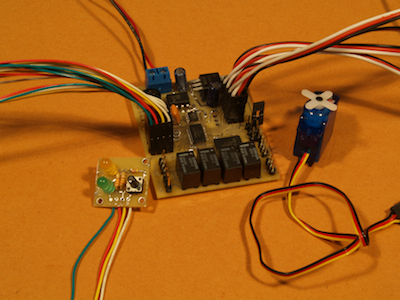
He is offering the schematics and source code free at the moment. I understand that pricing for pre-assembled units is to follow soon. The possibility to control other devices (turntables, signals, gates, etc.) is also present with code modification.
A short video of a beta unit in operation is available courtesy of the Model Railcast Show.
2.04.2009
iPodius
The Model Railcast Show is coming up on episode #50. Recent podcasts have covered benchwork construction and DCC topics.
The informal, ad-lib presentation style may not appeal to every taste but there is certain charm and spontaneity that you simply won't get with a script. Listening to the show often feels like you're just having a bunch of (knowledgable) guys over to your basement layout for a work session.
I have to applaud the primary host, Ryan, who is sticking his neophyte neck out every single show - letting everyone know he is not an expert model railroader. The honest (and sometimes basic) questions he asks his guests have forced me to re-think some of the things I "know" about the hobby and how to approach it. This has improved my understanding of areas I had taken for granted, and made me appreciate many aspects in different ways.
I find myself looking forward to each weekly installment. You do not need an iPod to listen to the programs; Quicktime, iTunes, or an mp3 player will do fine.
what?
There continues to be a lot of discussion about what it really means to be a model railroader. Frankly it's going mean a different thing to each person. It doesn't follow that any one approach or definition is going to be better or worse than any other.
One could argue that someone who only buys RTR is not really a model railroader. Unless, perhaps, their efforts are focused on modelling operations rather than equipment? You could also argue that someone who only builds models of equipment and doesn't have a layout to run them on isn't really a railroad modeller, just a model builder, right?
It really is too bad that so many people are spending so much time in specious arguments backed with dubious data. In the end, it's the person who isn't spending all of their time yakking it up in the discussion forums who is actually getting models built and running trains.
And that's what this whole exercise is supposed to be about, isn't it?
down time
Circumstance has temporarily dictated sedentary pursuits.
Having some time not otherwise occupied, I finally had a chance to hook up a LocoBuffer-USB from my PC to a Digitrax DB150 command station/booster. The free JMRI software allows you to program decoders, control the command station, operate virtual on-screen throttles, create CTC panels, and many other functions. Full details of hardware & OS support are on the website.
My main reason for implementing this software and hardware is to program decoders. I have one diesel, an S Helper Service SW9, with two decoders (Lenz Gold-JST & Soundtraxx DSD100LC-EH) which is a particular pain to program and keep track of the CV values. Hopefully I will be able to synchronise the sound & motion better using the graphical programming "DecoderPro" portion of the JMRI package.
I did notice that there is a mechanical problem with the diesel that I was unable to see or hear in the large auditorium of the last show. I will have to disassemble the loco to check out the issue. It seems that one of the pickup wipers is "clicking" during the wheel rotation.
1.08.2009
questions, questions everywhere, so let's just stop & think
There are a lot of questions flying around in discussion forums. Regular appearances are made by the likes of "What size turnouts should I use", "What colour should my fascia be", "How do I lay track", and "What rail code should I buy"? Reference Byron Henderson's slightly tongue-in-cheek post What sized t-shirt...?.
What can be considered very basic questions are asked for a variety of reasons. While some instances are a real search for answers they can also arise from pure laziness, the desire to pontificate, or even attempts at bushwhacking the self-proclaimed experts who populate all corners of the Internet.
A real tyro needs this basic information just to get started. Magazines like Model Railroader & Railroad Model Craftsman and 'getting started' books by Kalmbach & Carstens Publishing excel at presenting introductory material in an easy-to-digest, highly pictorial manner. The big trouble you run into on a typical forum is that one seemingly simple question will generate dozens of responses, often contradictory or even incomprehensible to a newbie. It's great if the inquirer can manage to sift through the resulting text to figure out what to do but it may leave them more confused and worse off than they started.
For many of these questions, the answer is going to be based on personal preference (what scale, what colour, what era) and no one (especially a stranger, even an expert one) will be able to tell you what your personal likes and dislikes are. The newbie will simply have to decide for his or herself. This will require personal effort in historical research, visits to clubs/layouts/real locations, watching videos, and simply reading books & magazines on the subject(s) coupled with some trial-and-error, hands-on work in order to get some idea of what's involved and how capable you are.
Once the initial hurdles of a) simply understanding model railroad specific terms and phrases, and b) learning about your own preferences are overcome, the newbie will be able to ask some informed questions and (hopefully) make better sense of the answers. Choice of an approach (freelance, prototype, protolance) and an honest evaluation of your own skills will shake out some of the remaining details (era, theme, turnout #'s, rail code, etc.)
The Internet has made it tremendously easy to cast a question out into a vast pool of knowledge but it useful to remember that, when fishing in a pool, you do not always hook into something you can digest. Don't rely on others to tell you what to do, or expect the "right" answers to arrive at the surface without getting your own feet wet.
Subscribe to:
Posts (Atom)