I've been meaning to update my series of posts "modular musings" on this blog for quite some time.
Recent events and discussions with other modellers reveal that portable layout design, DCC systems, and electrical wiring (in general) are all topics that could stand some review and discussion.
Over the next few weeks, I will try to update these posts with more observations and links to relevant information.
Stay tuned...
Showing posts with label DCC. Show all posts
Showing posts with label DCC. Show all posts
2.01.2013

timing is everything
Lots of stuff going on lately.
Model Railroadish stuff, mostly.
A trip to the Amherst Railway Society's big train show in Springfield, MA offer ample chance to blow one's mind with possibilities. Add to that a heaping goodie basket of new things from the various vendors...
Travelling with local traction modeller extraordinaire Roger Chrysler was a real treat; I'd be more than happy to repeat the process for any train show I can think of.
However, unexpectedly, I had to debug the S Scale Workshop's layout on Friday afternoon. Due to time constraints, I was attending the show for Saturday only, and had not anticipated being able to enter the show grounds ahead of time. Through sheer luck & good timing I was in the same building as the layout late in their setup phase. Workshop member Andy Malette of MLW Services spotted me while I chatted with Jeff Adam of Motrak Models. Andy hauled me back to the layout to see what was going on.
The DCC system was giving the group fits. I found several things wrong over the course of the next hour or so:
The first three issues were isolated and sorted out fairly quickly by halving the layout's busses until the faults revealed themselves. The last item could not be readily repaired as that Tortoise is part of a complex control panel comprised of momentary pushbuttons and LED route indicators that doesn't lend itself to tracing wires unless that module set is laying on its side; which was not practical at that point in the setup.
One issue I should have dealt with was to ensure that the Command Station was centrally located along the track buss. The layout was about 80' in length this time around thanks to some excellent new modules built by member John Johnston. Our habit has been to hook the Command Station into the buss about 8' from one end. Not such a big deal when the layout is in the 40-50' range, but it gets much worse as track buss lengthens. Next time...
In the end, the layout was operational for the weekend. I was able to come back on Saturday after lunch and, while the rest of the crew ran trains, chat with the general public and other modellers who viewed the modelled scenes and trains. Some great questions were asked and many compliments were made.
It came as a pretty big surprise to the crew when the Amherst Railway Society's committee stopped by at about 4 PM and awarded us "Best in Show - Layouts" for 2013. We are certainly honoured to be recognised in this manner. Needless to say, spirits were running high for the rest of the weekend.
Model Railroadish stuff, mostly.
A trip to the Amherst Railway Society's big train show in Springfield, MA offer ample chance to blow one's mind with possibilities. Add to that a heaping goodie basket of new things from the various vendors...
Travelling with local traction modeller extraordinaire Roger Chrysler was a real treat; I'd be more than happy to repeat the process for any train show I can think of.
However, unexpectedly, I had to debug the S Scale Workshop's layout on Friday afternoon. Due to time constraints, I was attending the show for Saturday only, and had not anticipated being able to enter the show grounds ahead of time. Through sheer luck & good timing I was in the same building as the layout late in their setup phase. Workshop member Andy Malette of MLW Services spotted me while I chatted with Jeff Adam of Motrak Models. Andy hauled me back to the layout to see what was going on.
The DCC system was giving the group fits. I found several things wrong over the course of the next hour or so:
- three custom made, twisted-pair (Cat5?) LocoNet cables were causing the throttle buss to spasm
- one LocoNet UP5 panel was not daisy-chained correctly
- a rail gap had closed up at one turnout, shorting the track buss
- a damaged Tortoise had been replaced but the frog power routing had been compromised, shorting the track buss when the points were aligned for the main.
The first three issues were isolated and sorted out fairly quickly by halving the layout's busses until the faults revealed themselves. The last item could not be readily repaired as that Tortoise is part of a complex control panel comprised of momentary pushbuttons and LED route indicators that doesn't lend itself to tracing wires unless that module set is laying on its side; which was not practical at that point in the setup.
One issue I should have dealt with was to ensure that the Command Station was centrally located along the track buss. The layout was about 80' in length this time around thanks to some excellent new modules built by member John Johnston. Our habit has been to hook the Command Station into the buss about 8' from one end. Not such a big deal when the layout is in the 40-50' range, but it gets much worse as track buss lengthens. Next time...
In the end, the layout was operational for the weekend. I was able to come back on Saturday after lunch and, while the rest of the crew ran trains, chat with the general public and other modellers who viewed the modelled scenes and trains. Some great questions were asked and many compliments were made.
It came as a pretty big surprise to the crew when the Amherst Railway Society's committee stopped by at about 4 PM and awarded us "Best in Show - Layouts" for 2013. We are certainly honoured to be recognised in this manner. Needless to say, spirits were running high for the rest of the weekend.
2.10.2009
servos you right
Duncan McRee has developed a DCC accessory decoder to enable R/C servos to control turnouts.

He is offering the schematics and source code free at the moment. I understand that pricing for pre-assembled units is to follow soon. The possibility to control other devices (turntables, signals, gates, etc.) is also present with code modification.
A short video of a beta unit in operation is available courtesy of the Model Railcast Show.
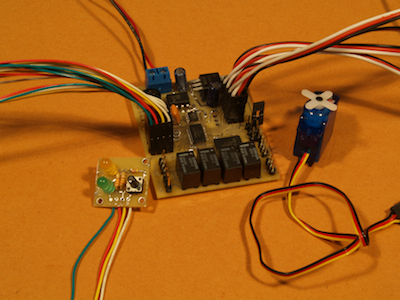
He is offering the schematics and source code free at the moment. I understand that pricing for pre-assembled units is to follow soon. The possibility to control other devices (turntables, signals, gates, etc.) is also present with code modification.
A short video of a beta unit in operation is available courtesy of the Model Railcast Show.
2.04.2009
down time
Circumstance has temporarily dictated sedentary pursuits.
Having some time not otherwise occupied, I finally had a chance to hook up a LocoBuffer-USB from my PC to a Digitrax DB150 command station/booster. The free JMRI software allows you to program decoders, control the command station, operate virtual on-screen throttles, create CTC panels, and many other functions. Full details of hardware & OS support are on the website.
My main reason for implementing this software and hardware is to program decoders. I have one diesel, an S Helper Service SW9, with two decoders (Lenz Gold-JST & Soundtraxx DSD100LC-EH) which is a particular pain to program and keep track of the CV values. Hopefully I will be able to synchronise the sound & motion better using the graphical programming "DecoderPro" portion of the JMRI package.
I did notice that there is a mechanical problem with the diesel that I was unable to see or hear in the large auditorium of the last show. I will have to disassemble the loco to check out the issue. It seems that one of the pickup wipers is "clicking" during the wheel rotation.
3.19.2006
GP7
Just finished a decoder installation in an Atlas GP7 (N scale). The decoder recommended was the NCE N12SR. It is, in fact, bigger than I would like. You have to mill away a significant portion of the frame in the short hood area to permit both it and the headlight LED to fit inside the shell. Even so, the LED body had to be ground down for clearance. 1/4W, 1K resistors were installed to limit current on the LEDs.
I would have liked to use the Lenz LE0511W or the new NCE Z14SR instead, along with a pre-milled frame from either Aztec or Southern Digital. Oddly enough, at the price they sell their frames, it's more cost-effective than using my own mill (though not as convenient).
One oddity was the refusal of the F0F/F0R to work as intended. The lamps would always come on opposite to the direction of travel, regardless on the NDOT setting in CV29. The decoder also refused to take a function remap of the WHITE and YELLOW leads using CV33 and CV34. I ended up swapping the WHITE and YELLOW leads at the decoder itself to straighten out the issue.
I will say that the NCE decoder makes for smooth running.
10.17.2005
current projects
A few more DCC installs are in process. A CPR D-10 in brass (PFM), a Spectrum Doodlebug, and a P2K GP38-2. These will keep me busy for the rest of the week at least.
The brass loco will prove to be the most time consuming. Electrical pickup is poor at best. Extra wipers will need to be added where possible, and the motor will have to be isolated from the chassis.
There should be just enough room above the motor to fit the decoder in the cab itself, rather than resorting to a tender installation.
8.16.2005
latest venture
I've just started doing decoder installations for a local hobby shop. As you can imagine, very few people are asking for external assistance to drop in a PnP decoder. This means that the vast majority of work I will get from this source will be the most troublesome types.
For instance, my very first task was to stuff a DZ123 decoder into an N-scale, Kato Heavy Mikado. This has a split frame pickup like many other N-scale products. Luckily there are some basic directions from others who have done this before; however I have come to disagree with some of the steps in their process description - I'll address the deficiencies next time I have to do one of these Mikes.
All that aside, this first unit is back together and tested. I must say I'm fairly impressed with the operation of recent releases of N scale steamers. They certainly aren't like the ones I used to fight with to get running...
7.13.2005
MRC sound + Bachmann Mogul (part 2)
MRC decoder #0001627 (~ $90 CAD)
Just finished installing one of these decoders in the Bachmann Mogul. It's a decent sounding unit, which I bought primarily for the chuff; it is less mushy than most that I've heard. It includes a 28mm, 8 Ohm speaker and is apparently capable of driving two speakers of this size.
It has headlight/reverse light, basic motor control (no BackEMF or high frequency PWM) with programmable accel/decel & start voltage, and 12 audio functions.
At the moment, I'm having some difficulty getting the chuff rate set with respect to driver RPM. There is no way to use a sound cam with this decoder.
Volume can be controlled only to the extent of loud, quiet, and off.
The speaker was installed in the tender facing downwards. The decoder was also installed in the tender with all wiring except the yellow reverse light passing forward into the locomotive. A slot was milled in the right side of the chassis casting to route the wires to the motor, pickups and headlight.
The Mogul itself is far from complete, with many more details to be re-applied and new ones created in order to alter its appearance.
6.23.2005
I've got no strings...
I've finally had a chance to hook up the UR90 InfraRed receiver panel from Tony's Train Exchange (excellent service) and test the UR4 utility throttle I picked up at the Credit Valley Railway (terrific local hobby shop).
I noted a slight delay in some of the command transmissions, but nothing to worry about so far. My test setup emulates a fascia mount with the UR90 at hip level. This is not an optimal arrangement for picking up line-of-sight signals. Ideally the panel should be higher up and father away, nearer to a theorectical backdrop plane in order to receive signals from a wider arc.
The setup requires a 12VAC wall-wart for the UR90 panel and a 9V battery installed in the throttle itself. It's a simple and inexpensive way to go wireless now that the basic Digitrax throttles come with IR functionality included. For an around-the-wall layout, you'll likely need more than one of these receivers to provide adequate coverage for all throttles.
6.08.2005
MRC sound + Bachmann Mogul
After hearing a demo of the MRC synchro sound decoder, I decided I had to have one. The size of the decoder and speaker renders it nearly impossible to install in either of the On30 Porters. The Mogul, however, has a huge tender and is relatively easy to disassemble.
The Mogul is getting a facelift in the proceess of the installation.
- Cal Scale brass smoke stack
- Tomalco brass tender hatch
- Banta laser-cut wooden cab
- new paint job
All of the piping and accessories have been stripped from the boiler and it has been primed Polly-Scale MOW Gray and then Engine Black. A layer of Testors Glosscote will cover the black to represent the spit-and-polish expended when a road is still new (and solvent). Due to excessively rough handling by Canada Post during the Mogul's trip from BC to Ontario, a number of details must be repaired/replaced on the loco and tender. Luckily, none of the damage affected the running qualities.
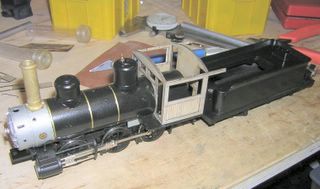
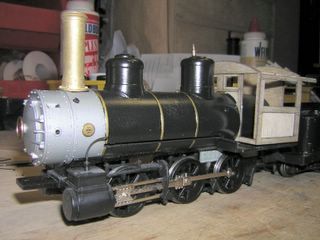
As usual, the camera doesn't lie and shows off the flaws in the finish. Still more work to do on the boiler and stack. The smokebox also needs several touchups as the masking tape unexpectedly pulled off some of the factory graphite finish.
It's also obvious that I require some seriously improved lighting capabilities if I'm going to take decent construction photos.
The Mogul is getting a facelift in the proceess of the installation.
- Cal Scale brass smoke stack
- Tomalco brass tender hatch
- Banta laser-cut wooden cab
- new paint job
All of the piping and accessories have been stripped from the boiler and it has been primed Polly-Scale MOW Gray and then Engine Black. A layer of Testors Glosscote will cover the black to represent the spit-and-polish expended when a road is still new (and solvent). Due to excessively rough handling by Canada Post during the Mogul's trip from BC to Ontario, a number of details must be repaired/replaced on the loco and tender. Luckily, none of the damage affected the running qualities.
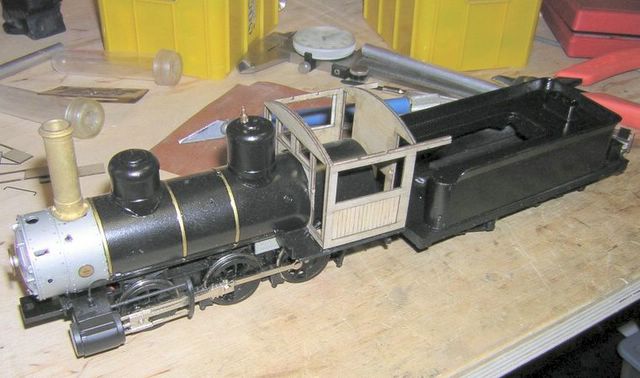

As usual, the camera doesn't lie and shows off the flaws in the finish. Still more work to do on the boiler and stack. The smokebox also needs several touchups as the masking tape unexpectedly pulled off some of the factory graphite finish.
It's also obvious that I require some seriously improved lighting capabilities if I'm going to take decent construction photos.
6.03.2005
DCC out of storage
The GenesisII DCC system I purchased a number of years ago is up and running again. This discontinued Digitrax starter set had all of the features I was after at the time, and is still compatible with all of their current product line.
I downloaded the latest Windows software for the optional PR-1 decoder programmer, and quickly had my old Sn42 diesel running with directional headlights & acceleration factors in just a few mouse clicks.
I am aware that the new, JAVA based DecoderPro software coupled with the LocoBufferII is a popular choice for decoder programming via the PC and Mac using serial or USB ports.
Given the interfaces on most digital throttles, I cannot see using them to program more than a few basic CV values to get up and running. A computer offers a point-and-click interface that allows you to save & load profiles for fleets of motive power and draw speed curves directly on-screen.
5.26.2005
back to the trains
Planning for the next On30 modular group "build session" is underway. We have not decided upon which DCC system we will be using for exhibitions. The decision to go wireless was very easy; the benefits are worth the initial expense. However, each of us has a different ideal throttle configuration.
I am a Digitrax user. I prefer their UT series "knob-and-switch" throttles. Not the most robust construction, but certainly adequate to task. The new UT4 & UT4R have full function control and 4-digit addressing. For programming I always try to use the PR-1 programmer PC interface.
I have used Lenz and find it very nicely built. Both of their pushbutton and knob style throttles are fine and feel comfortable to use. The CVP radio throttle add-on system for Lenz is OK. I found the narrow handheld a little uncomfortable, but I suspect that some trimming of flash on edge the plastic casing will soften it up. Not having used NCE or Atlas, I cannot yet comment on their "feel".
I've also had the chance to use old carrier-based CC systems like Keller OnBoard and PSI Dynatrol. The PSI throttles with full train-brake simulation are a real treat. I don't know how well they've implemented that feature now that they offer a DCC compatible system.
I'll bring the Digitrax setup to the next build session and let the other members have a go with it. The plan is for each of us to buy one radio throttle (for whatever system we decide upon) and split the cost of a receiver panel 4 ways.
Subscribe to:
Posts (Atom)